On Jan. 3, US special forces landed in Venezuela and captured acting President Nicolás Maduro Moros. Opinions on the true motives remain split. On one hand some argue this operation conducted by the President was well within his rights and necessary to protect the US from illegal drug trafficking. On the other, some believe it to be about seizing Venezuelan oil.
At 10:24 p.m. ,without previous congressional approval, President Trump gave go to the U.S. Army’s elite Delta Force, to begin the controversial Operation Absolute Resolve. Helicopters touched down at 2:01 a.m. at the military complex in Caracas where they began the raid of Maduro’s compound.
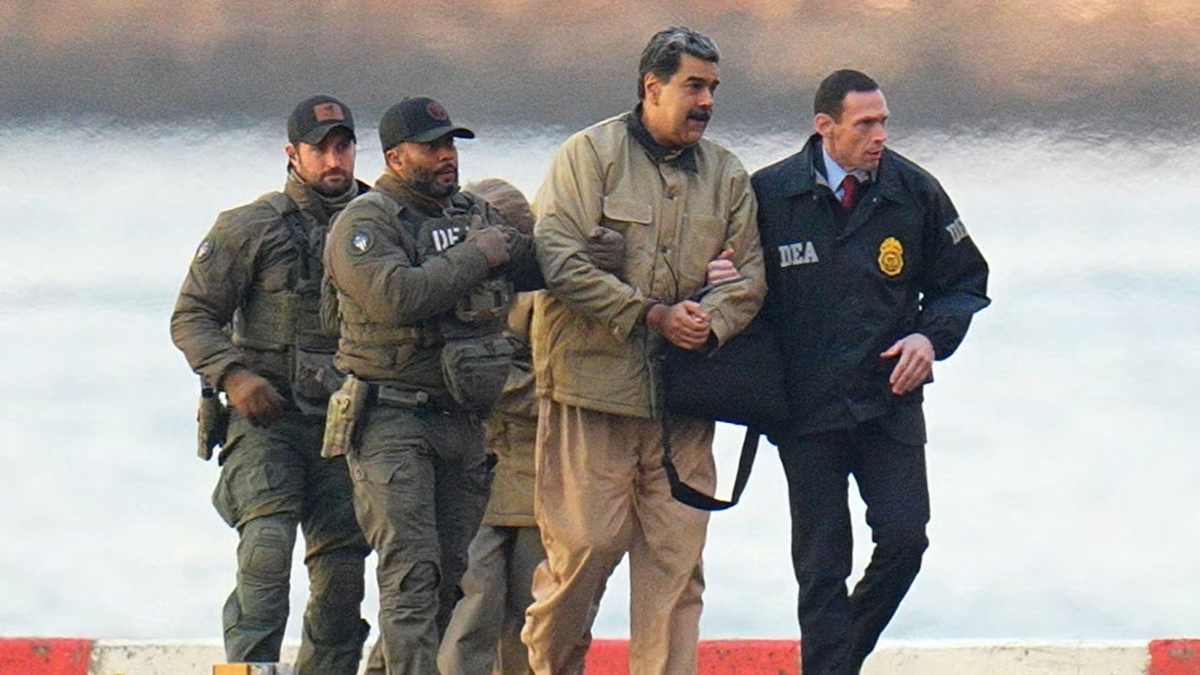
With no American casualties, Maduro and his wife, Cicilia Flores were successfully extracted and boarded onto the USS Iwo Jima where they were video-taped almost non-stop to prevent future allegations of torture.
From there, they were flown to Stewart Air National Guard Base in New York. Attorney General Pam Bondi announced a superseding indictment, charging the two with narco-terrorism, drug trafficking, and weapons offenses at the MetroPolitan Detention Center in Brooklyn.
Maduro and his wife have both pleaded not guilty to all charges. During his initial court appearance on Jan. 5, Maduro claimed to be a prisoner of war and the legitimate President of Venezuela who was kidnapped. Despite this, a judge then ordered the two to remain detained at the MDC in Brooklyn without bail where his next court hearing is scheduled for March 17, 2026.
With Maduro gone, Vice President, Delcy Rodríguez was sworn in as acting president in Caracas on Jan. 5. To avoid further conflict with the US, his administration has released 116 political prisoners with some reports claiming this was an order directly from Washington D.C and Trump’s cabinet.
The Trump administration has stated it will “exert tremendous leverage” over Venezuela, particularly with regards to the country’s oil reserves which is the largest in the world. Many believe this to be the prime motive for Trump’s operation in Venezuela: extracting vast amounts of oil and asserting control over the country’s natural resources.
Over 80% of Venezuelans don’t support Maduro and were relieved upon his removal. Most didn’t even refer to Maduro as President rather a dictator who established authoritarian rule and is responsible for the disastrous condition of Venezuela’s economy. So, while many are glad Maduro’s oppressive rule has come to an end, a fear colored by the uncertainty of Trump’s true plan for Venezuela remains.