
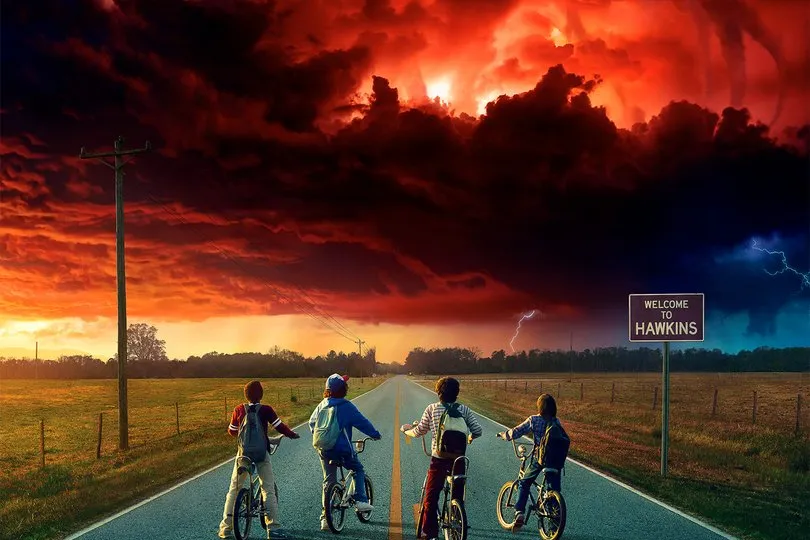
There was a shockwave that ran through the worldwide fan base over this past weekend with the release of the first four episodes of the much-anticipated fifth season of the Netflix series Stranger Things. After months of rumors about production issues, the delay in releasing the new season, and the almost three-year wait for fans to see the conclusion of the show, the initial portion of the final season delivered a dark, heavy, and fractured return.
The Duffer Brothers, the creators of Stranger Things, have proven in these episodes that they plan to deliver a final season unlike anything seen before. It’s evident from the very first few minutes of the season premiere that this will be a season with a different feeling of closure; the stories get tighter, the emotion grows deeper, and every decision made creatively has a reason and a purpose.
If you were to understand how these episodes have such a strong impact, it would be helpful to look at where the people creating these episodes came from. Stranger Things was created by Matt and Ross Duffer, two brothers who were relatively unknown until the success of Stranger Things in 2016. Their love for 1980s films helped define the show’s aesthetic; however, as the series progressed, the Duffer Brothers developed their own style that is no longer just an homage to the films of the 80s. Though I think moving on from the 80s aesthetic is definitely a misstep, as that was part of what defined Stranger Things itself, and it so largely relied on that. The new season no longer has the same energy and aura brought forth from that aesthetic, and with that being said, many others, including me, loved how it seemed to be a modern take on the 80s aesthetic; it felt very pronounced and immersive. A longtime collaborator of the Duffer Brothers, Shawn Levy also directed and executive-produced some of the episodes in the season. Returning to the series is cinematographer Caleb Heymann and musical duo Kyle Dixon and Michael Stein, who brought their signature sound of synth music to the series again; however, the sound of their music evolved into something more melancholic. As for the cast and crew of the series, Season 5 feels like a culmination, a team of experienced professionals who have grown technically and emotionally since the first episode.
The series picks up immediately after a period of great turmoil, and the town of Hawkins is left in a state of disarray, unsettling, and changed. The main theme of the first four episodes of Season 5 centers around the characters dealing with the consequences of all that has transpired during the prior seasons. The tone of the series is definitely darker than prior seasons; however, it is not presented in a heavy-handed manner. Instead, it is the type of dark that sits underneath the surface, simmering quietly. The pacing of the series is slow and deliberate, structured similarly to chapters within a large novel, rather than separate episodes. Each scene of the series contains an unmistakable amount of tension, which creates a feeling that the story is building toward something monumental, while allowing the viewer to process the emotional investment in the characters’ situations.
In addition to the new tone and pace of the series, the acting in the series has also taken on a more serious and mature tone, with frankly, some of the performances being not very good. Most notably, Mike, played by Finn Wolfhard, and Will, played by Noah Schnapp, along with other side characters, had very poorly acted-out scenes. I don’t even particularly know what it is that turned me off from their acting, but I just remember watching it and thinking that it was not very good. Millie Bobby Brown delivers one of her best performances as Eleven in the series to date. She uses a more controlled approach in her portrayal of Eleven, using less of the explosiveness that she had used in her earlier seasons and more of a subtle, internal struggle. The emotional weight that she brings to the role feels heavier, as if the character is lugging years of history in even the smallest actions. Gaten Matarazzo does another excellent job as Dustin, bringing a perfect balance of levity and depth to the role. In addition to being able to make the audience laugh, he is also able to bring a level of honesty to the role that keeps the series grounded and reliable. Sadie Sink provides a similar level of intense emotional weight that she provided in prior seasons of the series; however, in addition to that, she also adds a level of fragility and self-reflection to her portrayal of Max. David Harbour and Winona Ryder continue to provide the emotional foundation for the adult cast, with Harbour providing a steady and controlled presence, and Ryder providing a frenetic but passionate performance. It is apparent that all of the actors in the series are aware that this is the beginning of the end, and (some of) their performances convey that understanding.
The music in the series also plays a significant role in establishing the mood of the series. Dixon and Stein, who are responsible for the musical score of the series, continue to use their iconic retro-synth sound; however, the compositions are more measured and ominous in nature. The scores of the series often contain long sustained notes and slower rhythmic patterns, which establish a foreboding soundscape. The music is designed to prepare the viewer for the impending doom that has not yet occurred. The music is the sonic equivalent of a thick fog; it is murky, foreboding, and full of hidden dangers.
Thematically, the first four episodes of Season 5 deal with memory, trauma, and the fear of growing up too quickly. The characters in the series are forced to deal with echoes of their past as young adults who are unable to escape them. There is an ongoing struggle between wanting to move forward and the need to resolve the history of the past. On a larger scale, the series serves as a commentary on community and resilience; how a small town, a group of friends, and even a family can attempt to stay intact when the world around them is falling apart.
While the opening four episodes of the season are not as explosive as the first four episodes of Season 4, they were intentionally written in a more measured, atmospheric, and emotionally heavy way, as opposed to the more explosive and action-packed way of the prior season. It is this artistic restraint that contributes to the resonance of the series. The Duffer Brothers are not sprinting towards the finish line; they are slowly and deliberately building towards the conclusions of a cultural phenomenon. Based upon the first four episodes of the series, it appears that the final season of Stranger Things may go down as one of the most powerful goodbyes that modern television has given its audiences.




Cornelius • Mar 4, 2026 at 1:36 pm
I’ve seen stranger things, but this, this might be the strangest.